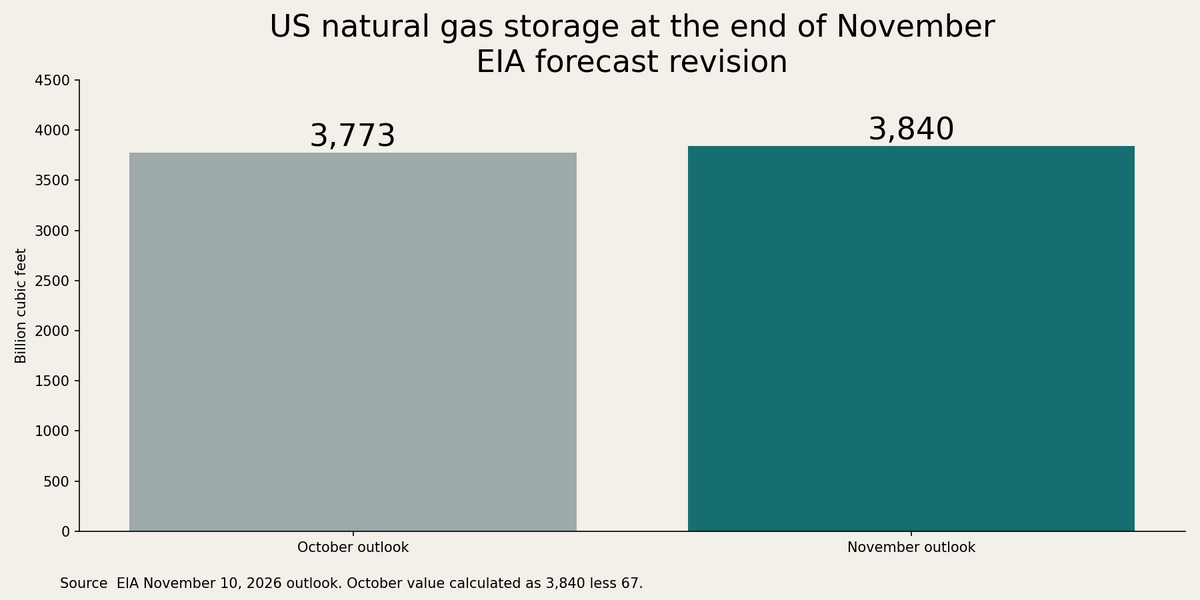
The US Energy Information Administration raised its projected end November natural gas inventory by 67 billion cubic feet in its November 10 outlook. The revision puts the winter question on domestic heating demand and the capacity available to export gas, rather than on overseas prices alone.
A larger projected buffer
EIA now expects 3,840 Bcf in storage at the end of November. Subtracting the disclosed revision gives 3,773 Bcf in the previous forecast. Both numbers are projections for the same month end, not successive weekly inventory observations.
The agency forecasts an average Henry Hub spot price of $2.87 per million British thermal units for November through March, 16% below its previous projection. This is a forecast seasonal average in US dollars, not a live quotation, futures settlement or price available for immediate trading. Model inputs were finalized on November 5, so the outlook does not specifically incorporate later events.
Export demand meets a physical limit
EIA describes export terminals operating near full capacity while international prices remain elevated. That distinction explains why strong overseas demand can coexist with a more comfortable US gas balance. A price incentive cannot move unlimited additional gas through a liquefaction plant that is already fully utilized.
Additional capacity can increase the outlet over time, but commissioning and reliable operations matter more than an announced opening. Pipeline access, maintenance and shipping can also interrupt the link between a domestic benchmark and the price an overseas buyer pays.
The implication is conditional. If mild weather persists and production remains sufficient, more gas can stay in storage even with strong export utilization. If cold weather accelerates withdrawals or production is disrupted, the projected cushion can shrink. A seasonal average can conceal short periods of sharp local price pressure.
Different businesses face different effects
For US producers, weaker realized prices can reduce cash receipts unless hedges or regional premiums offset the benchmark move. For industrial gas users, lower feedstock costs can ease pressure, subject to contract timing and transport charges. Neither effect should be inferred directly from the share price of a broad energy fund.
For LNG businesses, the overseas price gap is an incentive to use available infrastructure, not a measure of net profit. Purchase terms, contracted sales, liquefaction costs and freight affect the result. See the verified FOLITIC reference for Henry Hub natural gas for the benchmark identity.
What would change this reading
Compare subsequent weekly storage observations with the projected path and examine regional availability. A national inventory improvement does not remove every pipeline constraint. FOLITIC's earlier report on the South Central storage gap addresses a different question from this monthly forecast revision.
The decisive evidence will be weather driven consumption, actual withdrawals and export operations. A colder demand path would weaken the comfortable inventory scenario. Continued mild conditions and dependable production would strengthen it. This article does not claim an observed price reaction to the release.
Sources are EIA's November natural gas outlook and forecast overview. Original graphic compares the current forecast with the previous figure calculated from the disclosed revision.