News and analysis. 9 November 2026.
Endeavour Silver lowered its annual silver production outlook, putting ore quality and operating execution ahead of headline growth in quarterly output. The revised forecast points to less metal than previously planned, while higher expected processing costs at Terronera show why a production recovery does not necessarily restore margins at the same pace.
A smaller silver target
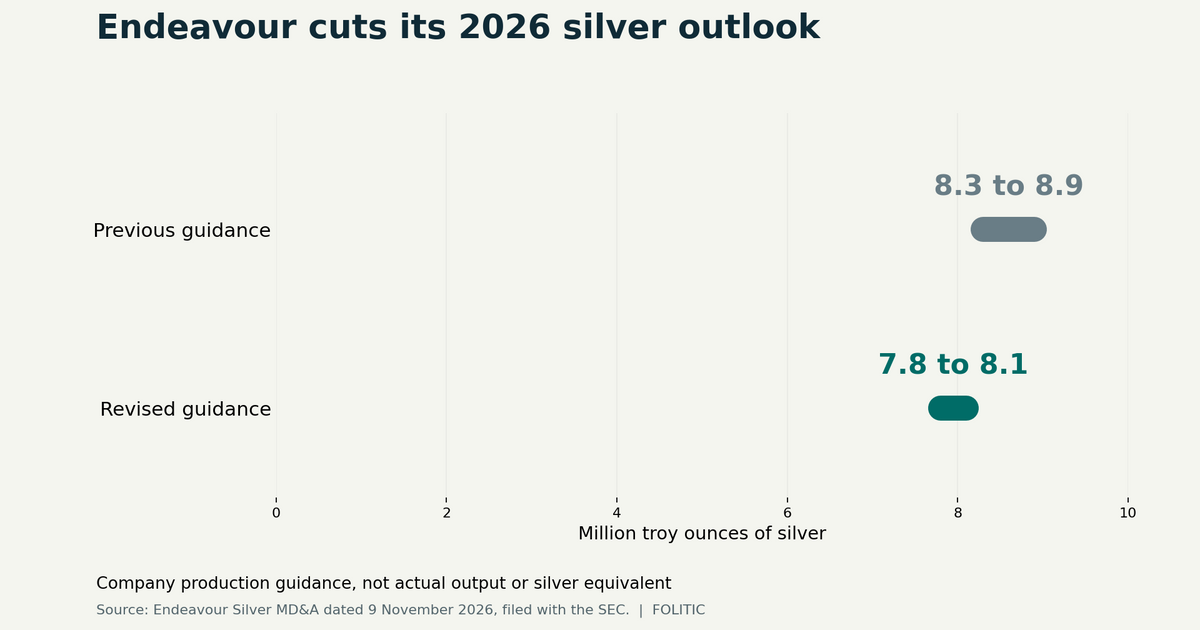
The company's management discussion filed with the SEC, dated 9 November, places 2026 silver production guidance at 7.8 to 8.1 million troy ounces, compared with 8.3 to 8.9 million previously. The midpoint falls from 8.60 million to 7.95 million ounces, a reduction of about 7.6%, calculated from the disclosed ranges.
These are company forecasts for contained silver production, not a measure of global supply or silver equivalent output. Silver equivalent combines several metals using specified conversion assumptions and cannot be read as physical silver.
Grades and costs complicate the recovery
In its results announcement, Endeavour linked the revision to performance at Guanaceví and narrower ranges at Terronera and Kolpa. It said higher metal prices allowed lower grade material to be mined economically, particularly at Guanaceví.
The company also raised Terronera's expected direct operating cost to US$170 to US$180 per tonne for 2026. It cited the delayed transition to liquefied natural gas, contractor demobilization, operating improvements and throughput lost during the blockade. This is a cost per tonne processed, not a silver price or a cost per ounce.
The distinction matters for the supply outlook. Processing more rock does not guarantee a proportionate rise in recovered metal. Ore grade and recovery determine how much useful output emerges from that rock. A lower grade mining sequence may make economic sense at stronger prices while still delivering fewer ounces than an earlier production plan assumed.
What would strengthen the outlook
For industrial users, the immediate signal is a reduction in one producer's planned contribution. It cannot by itself establish a worldwide shortage. Other mines, recycling, inventories and demand would need to be assessed before drawing a market balance conclusion.
For investors, the next operating reports should be read for the relationship between throughput, grades, recoveries and unit costs. Sustained processing alongside better recoveries and cost control would strengthen confidence in delivery. Further disruptions or weaker grades would undermine that confidence, even if higher selling prices supported reported revenue.
The comparison also depends on the benchmark. Output can rise against the previous year and still fall short of management's earlier plan. Investors should keep those two tests separate when judging whether operations are improving.
FOLITIC's guide to commodity cycles and production costs explains how operating economics shape supply decisions.
Original FOLITIC chart based on Endeavour Silver's 9 November 2026 management discussion. The ranges show annual company guidance, not actual production.