

Commodity and Inflation Swaps · Swaps Trading Guide
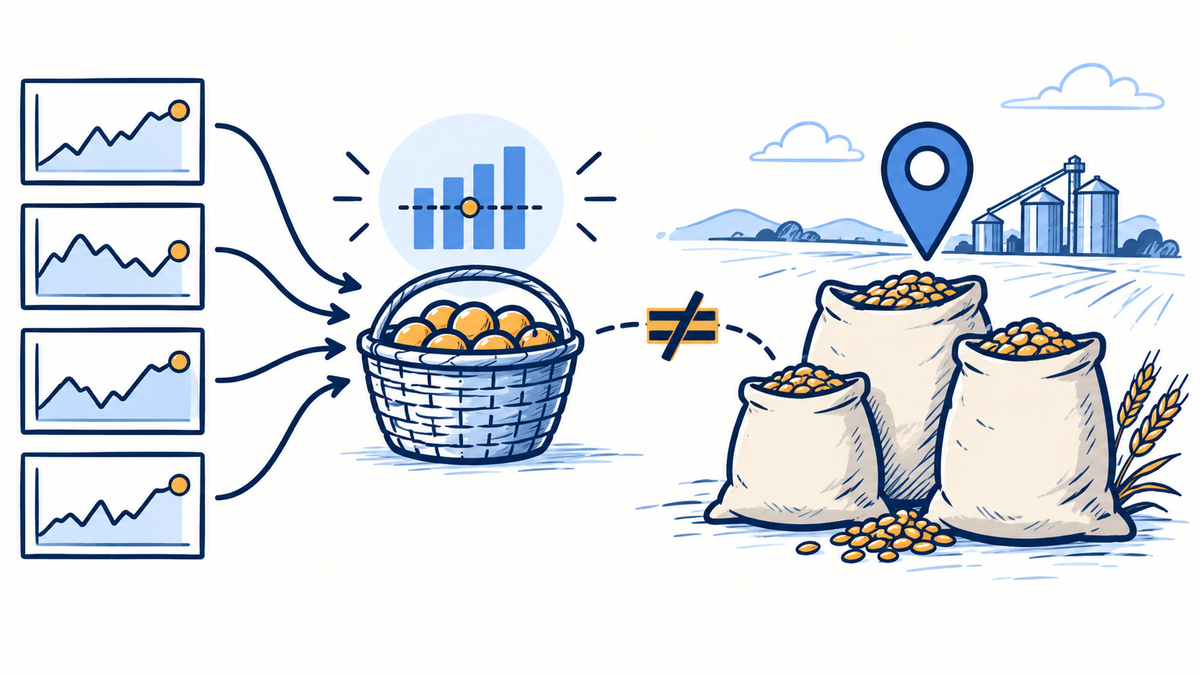
Average price swaps match a pricing window, not necessarily one day’s spot price. Volume and local price differences can leave a substantial residual exposure.
Read the averaging rule
A floating settlement may use an arithmetic average of specified daily assessments or a different contractual formula. The observation calendar, missing price rules and publication source matter. A monthly contract is not necessarily settled at the final price of the month. Using the wrong average can distort both expected payments and realized hedge results.
Calculate an illustrative average
If the only three eligible observations are $70, $80 and $90, an equally weighted average is $80. On 1,000 units against a fixed $78, a fixed payer receives $2,000. The example deliberately uses three observations to make the arithmetic visible. A real monthly contract would follow its complete observation schedule.
Measure volume mismatch
A firm hedging 10,000 units but consuming only 7,000 has 3,000 units of excess derivative exposure. If it consumes more than expected, the additional quantity remains exposed to market prices. A hedge ratio should reflect forecast uncertainty and be revisited as the physical requirement becomes clearer.
Track the physical basis
The delivered price can equal a benchmark plus transport, quality and regional premiums. A benchmark swap does not lock those premiums. Keep a separate history of physical price minus reference price and stress it alongside the commodity price. A stable benchmark can coexist with a sharply rising local purchase cost.
Try it yourself
A consumer buys 8,000 units at benchmark plus $6. The swap offsets only the benchmark. What cost remains from the local premium?
Show the worked answer
The local premium contributes $48,000. If that premium changes, the derivative does not automatically offset it, even with perfectly matched volume.
Further reading
Educational material, not a recommendation to transact. Numerical examples are hypothetical and simplify contract terms. Access, documentation, collateral and regulatory requirements depend on the product, jurisdiction and counterparties.
Continue learning
- Previous lesson: Commodity swaps for producers and consumers
- Next lesson: Inflation swaps and purchasing power exposure
- Explore all Swaps Trading Guide lessons


