Smart Sand's latest cash result is stronger than its sequential operating trend. The supplier reported $17.3 million of third quarter free cash flow after a $1.4 million outflow in the preceding quarter, even as sales volumes and adjusted EBITDA declined. For investors, the key issue is how much of that cash improvement can repeat.
The Nasdaq listed company, SND, attributed the cash improvement primarily to working capital conversion in its November 10 results. All amounts here are in US dollars.
Cash conversion is not the same as profit growth
Operating cash flow of $21.1 million less $3.8 million of capital expenditure produced the reported $17.3 million free cash flow. Adjusted EBITDA was $18.0 million, down from $18.7 million sequentially. Net income was $8.4 million.
Collecting cash tied up in working capital is economically useful. It reduces reliance on external funding. But a release of working capital cannot be assumed to recur indefinitely, particularly if business expansion later requires more receivables or stock. Treating one quarter's free cash flow as a permanent annual run rate would hide that distinction.
Investment requirements remain relevant
Management projected annual capital spending of $15 million to $20 million, excluding acquisitions and potential investment in new terminals. Spending through September was $10.8 million. Subtracting that amount leaves $4.2 million to $9.2 million against the stated annual range, before excluded investments.
That is a simple reconciliation, not a prediction that all remaining spending will occur on schedule. It shows why the latest quarterly capital expenditure may not represent the investment burden of a larger business.
A valuation based on cash should allow for the resources needed to support future sales, rather than counting the full benefit of expansion while ignoring the cash it consumes. Conversely, if the existing asset base can accommodate higher activity with limited additional investment, conversion could remain attractive.
The evidence that would strengthen the case
Several quarters of cash generation alongside stable margins would provide stronger support than a single working capital release. Renewed cash absorption, lower volumes or additional terminal investment would make the latest quarter less representative.
The company has improved its financial flexibility, but the report alone does not establish that the share price is inexpensive. This analysis does not assign a target price or a cash flow yield without a verified market value and a defensible normalised cash base.
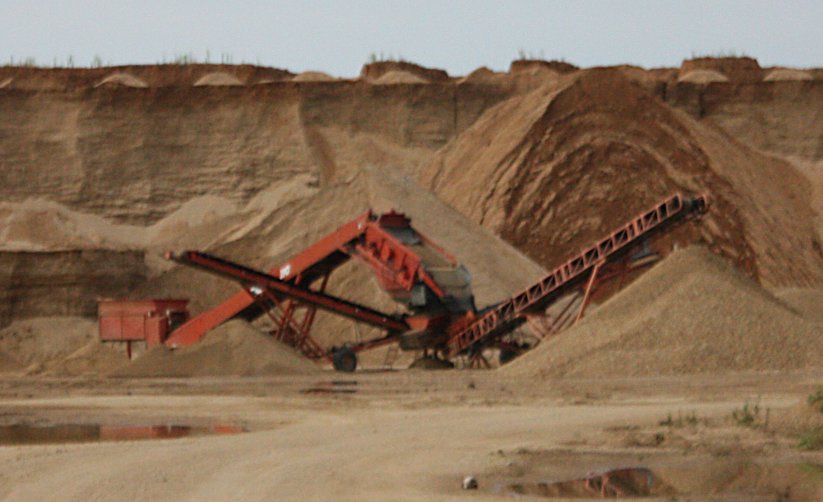
Archival sand mine illustration from Bratčice in the Czech Republic, not a Smart Sand facility. Photograph by I.Sáček, senior, released into the public domain.