Capital and Portfolio Risk · Futures Trading Guide
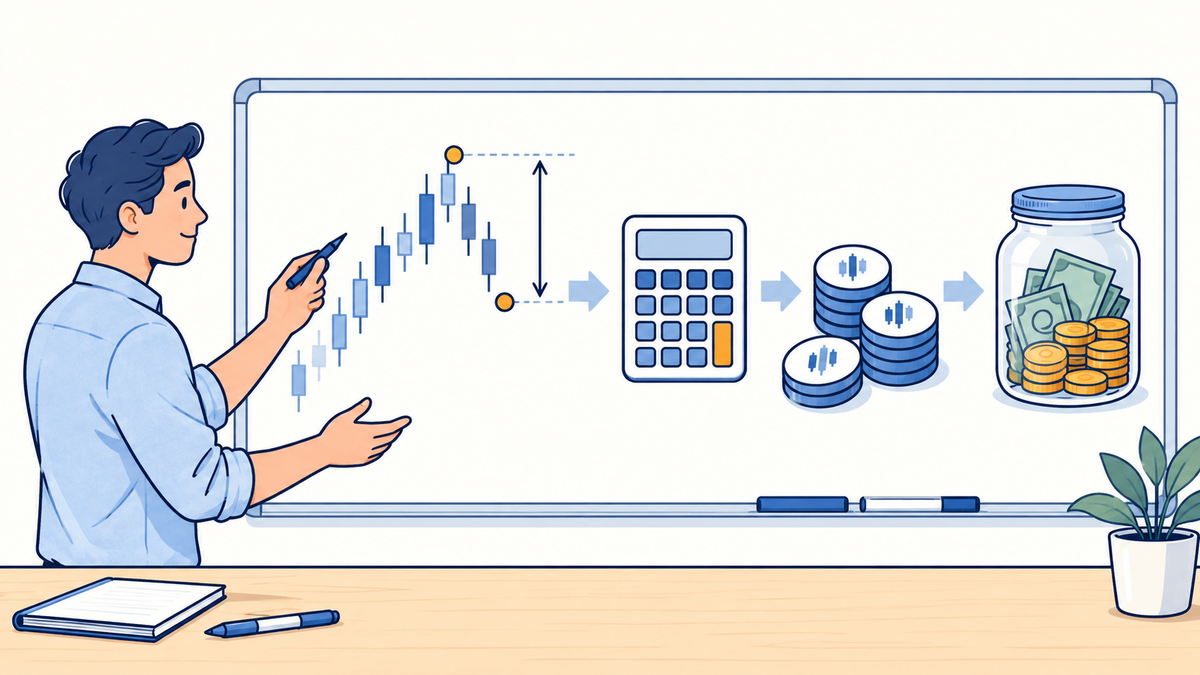
Position size should connect the trading idea to the cash that can be lost. Exchange margin answers a different question from an account risk allowance.
Set the loss allowance first
Decide the cash amount allocated to the trade within the wider portfolio plan. A percentage convention is a policy choice, not a universal safe level. Capital needed for living expenses or near term obligations should not be treated as loss absorbing trading capital. Define whether the allowance includes commissions and an execution reserve.
Translate the stop distance into cash
Assume an illustrative $30,000 account allocates 0.5%, or $150, to a trade. The planned stop is twelve ticks away and each tick is $5, giving $60 price risk per contract. Adding $10 estimated round trip costs and slippage makes $70 per contract. Rounding $150 divided by $70 down gives two contracts, with $140 estimated risk. Three would exceed the allowance.
Check collateral and stress separately
The position must also satisfy actual broker margin and cash reserve requirements. A gap of thirty ticks would lose $150 per contract before costs, exceeding the planned stop scenario. The sizing calculation is an estimate of intended risk, not a contractual loss ceiling. If even one contract exceeds either the risk or liquidity constraint, skipping the trade is a valid result.
Recalculate after every material change
Changing stop distance, adding contracts or rolling into a different product changes the calculation. Never round upward simply because the fraction looks close to the next whole contract. Evaluate aggregate exposure across simultaneous positions. A collection of individually small trades can create one large shared bet when their drivers are closely related.
Try it yourself
The loss allowance is $240. Planned price risk plus costs is $95 per contract. What is the largest whole quantity within that estimate?
Show the worked answer
Two contracts, representing $190. Three would represent $285 and exceed the allowance.
Further reading
Educational material. Prices, margins and strategy examples are hypothetical unless explicitly identified as contract specifications. They are not trade recommendations. Futures losses can exceed deposited collateral. Product terms and eligibility vary by venue and jurisdiction.