Spreads and Relative Value · Futures Trading Guide
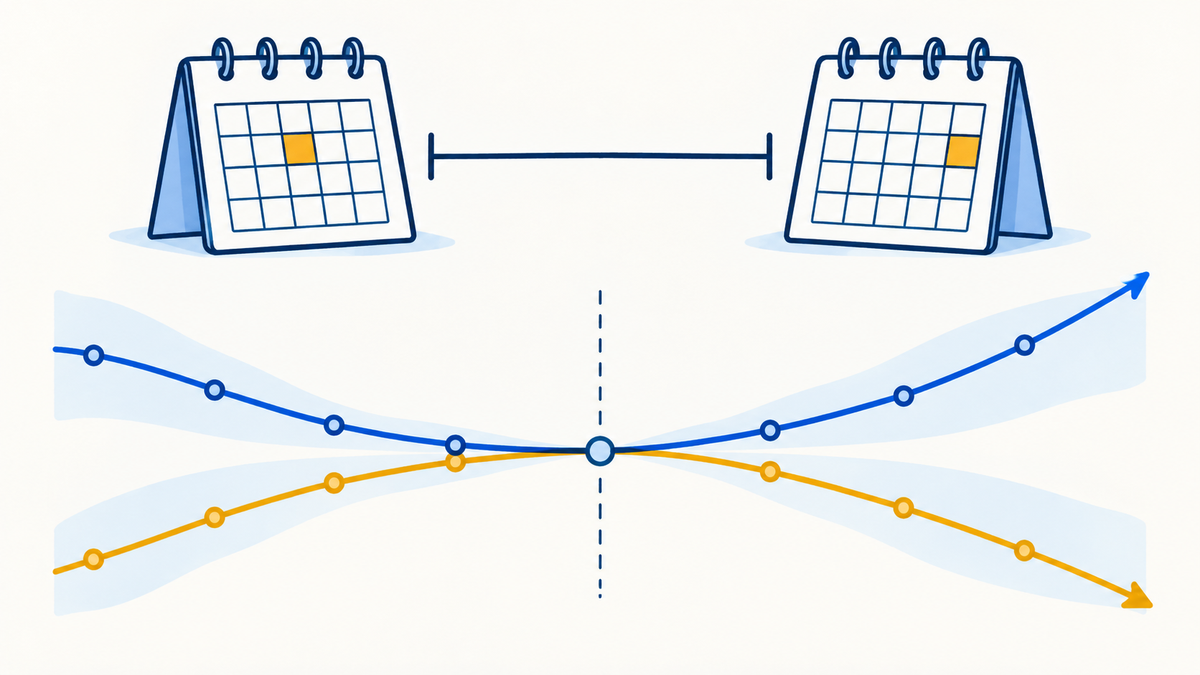
A calendar spread trades the relationship between two maturities. Its risk comes from changes in that relationship rather than the outright market alone.
Write the spread in a fixed order
Define the spread as nearby price minus deferred price for this lesson. Buying it means buying the nearby contract and selling the deferred contract in equal quantities when their units match. Another venue or screen may reverse the convention. Write the two actual positions beside the quoted spread before entering an order.
Follow both legs through the result
Assume identical fictional contracts with a $100 multiplier. The nearby contract is 90 and the deferred is 94, so the spread is negative four. Later they are 95 and 97, giving a spread of negative two. One long spread gains $200. The nearby long earns $500 and the deferred short loses $300. Both markets rose, but their different movement determined the net result.
Connect the relationship to economics
Storage costs, available inventory, financing and seasonal demand can affect the term structure. Harvest and delivery periods may alter the relationship between particular months. A familiar seasonal pattern is not a guarantee and can be overwhelmed by weather, supply constraints or rule changes. Compare the same economic months when studying history rather than merging arbitrary front contracts.
Manage the remaining obligations
A spread can move violently and its legs still have individual expiration and delivery obligations. Margin offsets can change or disappear. Model the spread’s executable bid and ask, fees on each leg, and the cost of rolling both sides. Verify the complete position after partial fills. A small net notional difference does not establish a small potential loss.
Try it yourself
You buy the nearby contract at 70 and sell the deferred at 72. You close at 68 and 71 respectively. Each has a $50 multiplier. What is the gross result?
Show the worked answer
The long loses $100 and the short gains $50. Net loss is $50, matching the spread change from negative two to negative three.
Further reading
- CME Group: Contango and backwardation
- CME Group: Futures spread overview
- CME Group: FX calendar spread execution
Educational material. Prices, margins and strategy examples are hypothetical unless explicitly identified as contract specifications. They are not trade recommendations. Futures losses can exceed deposited collateral. Product terms and eligibility vary by venue and jurisdiction.