Directional Strategies · Futures Trading Guide
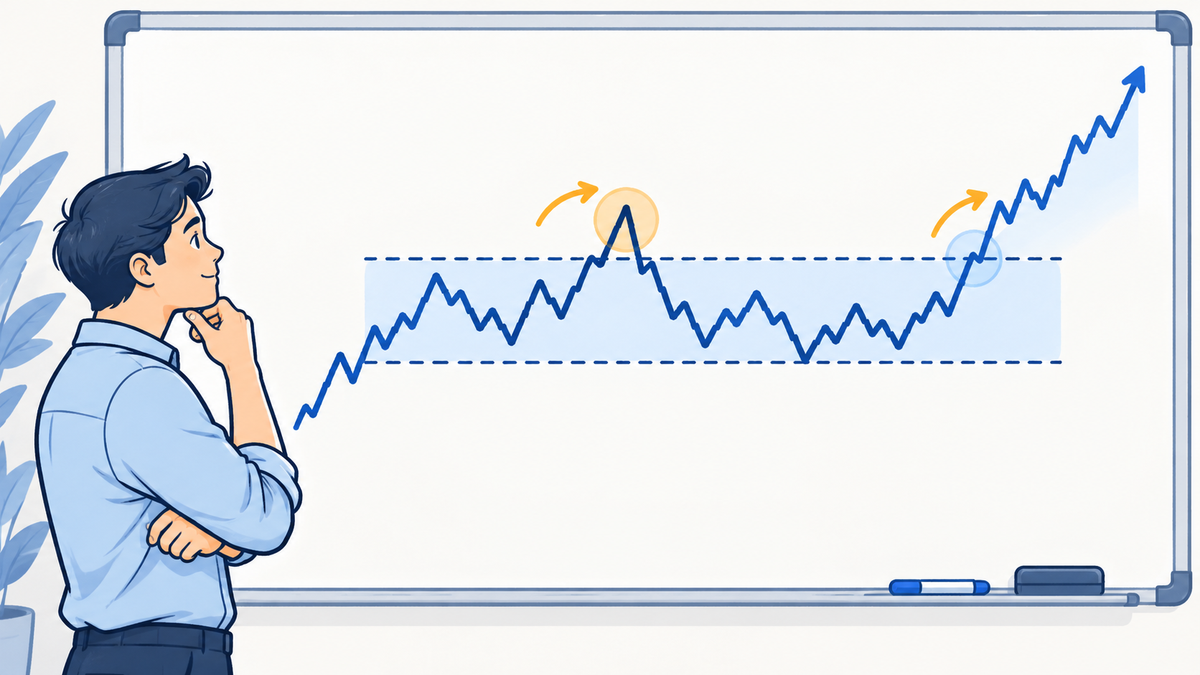
A breakout needs a defined boundary and a plan for failure. A dramatic candle alone is not an executable trading method.
Choose the reference session
An opening range depends on a specific clock, time zone and market session. A futures contract can trade before the cash market opens, so state which opening you mean. Fix the range interval before examining results. If the opening range ends at 10:00, its final high and low cannot be used to simulate an entry at 09:45.
Describe confirmation and invalidation
A hypothetical rule may require a completed bar beyond the range, a minimum distance, or a retest. Each condition changes the strategy and must be tested. Decide whether failure means returning inside the range, breaching a separate price level, or reaching a time limit. Avoid adding filters after each disappointing trade simply to improve the historical chart.
Calculate the cost of being wrong
Assume a fictional range runs from 200 to 204. A long fills at 204.50 with a planned stop at 202.50. At $25 per point, intended price risk is $50 per contract. A fill at 201.50 during a fast decline would lose $75 instead. Slippage and fees belong in the outcome. The breakout level does not guarantee that other traders will support the new price.
Count failures as carefully as winners
Log every valid signal, including signals skipped for operational reasons. Compare immediate reversals, delayed continuations and periods with no follow through. Include quiet days and volatile releases. A method that trades both directions may create several losses in a choppy session, so define the number of attempts and total session risk before the first entry.
Try it yourself
The range high is 150. A rule buys one tick above it, where a tick is 0.25. Is 150.10 a valid trigger price?
Show the worked answer
No. One tick above is 150.25, and the trigger must respect the contract’s valid price increments.
Further reading
- CME Group: Support and resistance
- CME Group: Futures order types
- Bailey and coauthors: The probability of backtest overfitting
Educational material. Prices, margins and strategy examples are hypothetical unless explicitly identified as contract specifications. They are not trade recommendations. Futures losses can exceed deposited collateral. Product terms and eligibility vary by venue and jurisdiction.