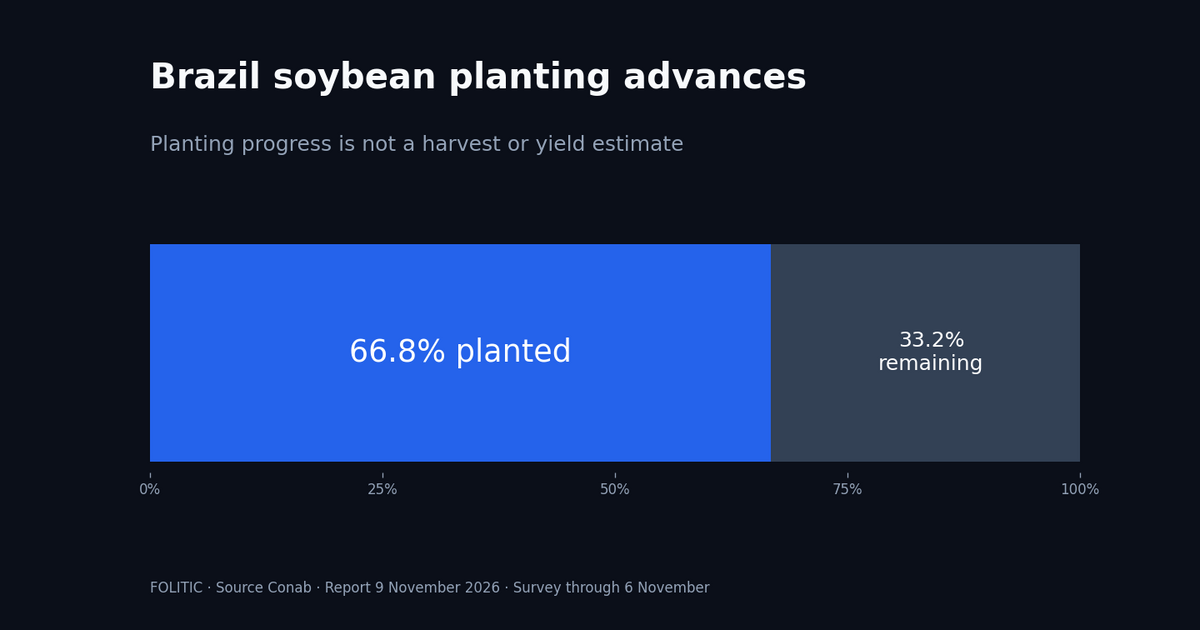
Brazil's soybean planting reached 66.8% in the latest Conab crop monitoring release, giving buyers an early indication of the developing 2026/27 supply pipeline. The national advance masks contrasting field conditions, with excess moisture affecting parts of the South and insufficient moisture delaying work elsewhere.
Conab published its weekly package on 9 November 2026. Its planting table covers 31 October through 6 November. The percentage measures planting progress, not the proportion of an eventual harvest already secured.
One national number contains different weather problems
The accompanying conditions report says sowing in Mato Grosso was nearly complete. In Paraná, most fields were in good condition, but excessive moisture and erosion impeded machinery and affected emergence. Santa Catarina faced both wet soils and delayed wheat harvesting. In Piauí, insufficient moisture kept planting stalled across most areas.
Those observations do not support a single national weather verdict. Rain can enable sowing where soil is dry while preventing machinery access where ground is already saturated. Local damage is documented, but the report does not establish a corresponding national tonnage loss.
The supply effect runs through timing and establishment
For international buyers, planting progress helps frame when a new crop might become available. It does not replace evidence about yield, harvesting, inland transport or export loading. A well advanced planting season can still encounter adverse weather later. Conversely, delayed fields may recover without a proportionate decline in output.
The near term analytical focus is the cost of establishing the crop. Replanting, additional field passes and disrupted spraying can raise costs even before a final yield effect is measurable. Farmers who incur those costs do not necessarily benefit from any broader rise in soybean prices.
Processors face a different question. Their margins depend on the relationship between bean costs and the value of meal and oil, as well as utilization and logistics. More expected beans alone does not determine whether crushing margins improve. Feed users care about meal availability, while edible oil and fuel users have different exposures to the oil component.
Keep the Brazilian crop separate from US price references
FOLITIC's Soybeans page identifies a Minneapolis terminal elevator cash reference for US No. 1 soybeans, quoted in USD per bushel. It is not a Brazilian farmgate bid or a CBOT futures contract. Its observation date must be checked before using it in a price comparison.
No current price reaction is asserted here. Currency changes, freight, export demand and competing origins can offset or amplify the influence of Brazilian field conditions. An expected supply increase need not translate into an immediate or uniform fall in prices paid by buyers.
The next evidence should test the national picture
Conab's next field observations should show whether wet areas regain access and dry areas receive enough moisture to plant. Its current weather outlook covers 9 through 16 November and remains a forecast. USDA's calendar also lists WASDE for 10 November at noon Eastern Time, a separate global balance sheet exercise rather than a measurement of this week's Brazilian fieldwork.
The original chart shows planted area and the calculated remaining share of 33.2%. It makes no estimate of production, yield or exportable stocks. Analysis is dated 10 November 2026.