American Tower priced $1.5 billion of senior unsecured notes on November 9, 2026, with expected net proceeds intended partly to repay revolving credit borrowings. The immediate credit question is how the transaction changes funding flexibility, rather than whether the headline amount represents new leverage or debt reduction.
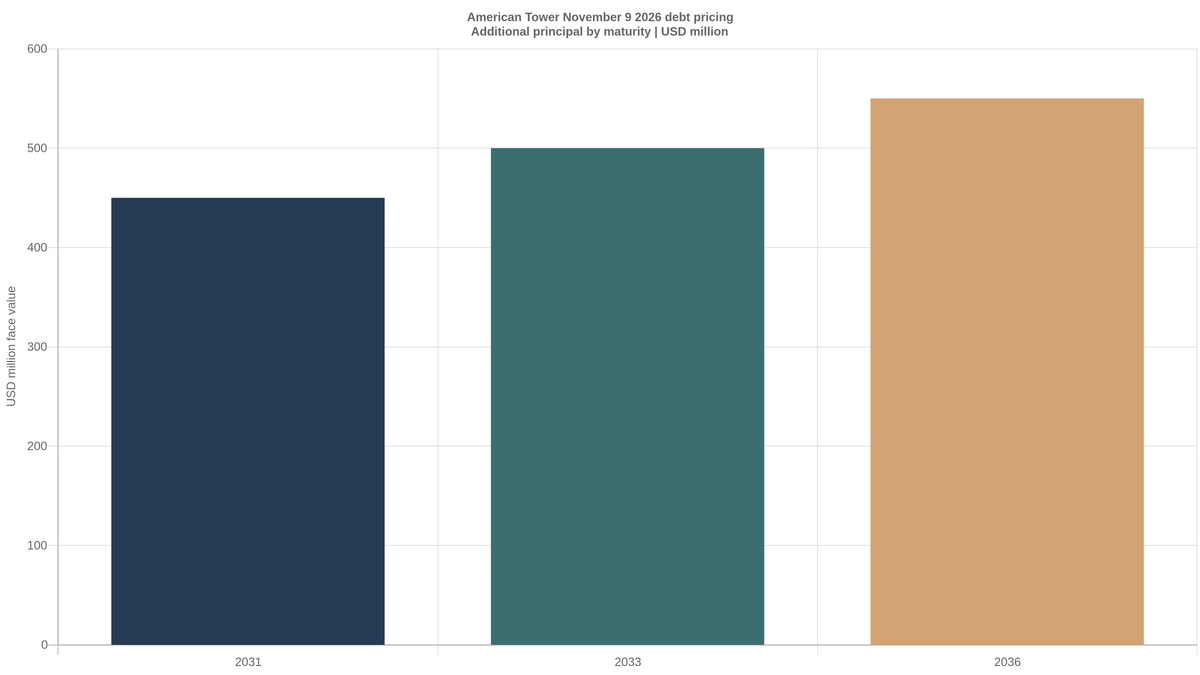
Three existing series receive additional principal
| Maturity year | Additional principal | Annual coupon | Issue price per $100 face value |
|---|---|---|---|
| 2031 | $450 million | 5.300% | 99.387 |
| 2033 | $500 million | 5.560% | 99.369 |
| 2036 | $550 million | 5.750% | 98.986 |
The SEC filing identifies American Tower Corporation as the issuer. Each tranche is to become fungible with the corresponding September 14 series. The prices are offering terms, not live bond quotes. Coupons are contractual interest rates, not yields to maturity.
The proceeds and the obligation differ
The filed release estimates net proceeds of $1,474.9 million after underwriting discounts and expenses. It identifies repayment under the $6 billion multicurrency revolver and general corporate purposes as intended uses. Pricing does not by itself confirm settlement or repayment.
The difference between face value and estimated net proceeds is $25.1 million. That amount includes the effect of pricing below par and transaction deductions. It should not be described entirely as underwriting fees. The contractual principal obligation is also different from the cash available to reduce other borrowing.
What would improve the credit position
If proceeds repay drawn revolving debt, available facility capacity could increase, subject to the agreement's terms. Replacing that borrowing with longer dated fixed coupon notes can change refinancing and interest rate exposure. It does not by itself lower total debt by the amount of the bond sale.
The cash flow test remains the ability to fund interest, investment and other obligations through the cycle. Senior unsecured status does not give holders a specific pledged asset merely because the issuer owns communications infrastructure. Nor does a successful pricing establish that subsequent refinancing will be available on the same terms.
The next evidence is settlement documentation, actual use of proceeds and the updated debt schedule. FOLITIC's guide to REIT debt maturities and refinancing risk provides context for comparing those obligations with recurring cash generation.
Original FOLITIC chart using the November 9, 2026 SEC filing. Bars show incremental principal by maturity year, not total company debt or proceeds.