

Valuation · Stocks Explained
Choose a consistent cash flow
A valuation of operations can use cash flow available to all capital providers after operating tax and necessary reinvestment. Discount that cash flow at an appropriate weighted cost of capital. Equity cash flow instead reflects borrowing and debt payments and uses the cost of equity.
Do not discount operating cash flow from a statement without considering capital spending and the treatment of interest. Build the forecast from revenue, operating margins, tax, working capital and investment needs.
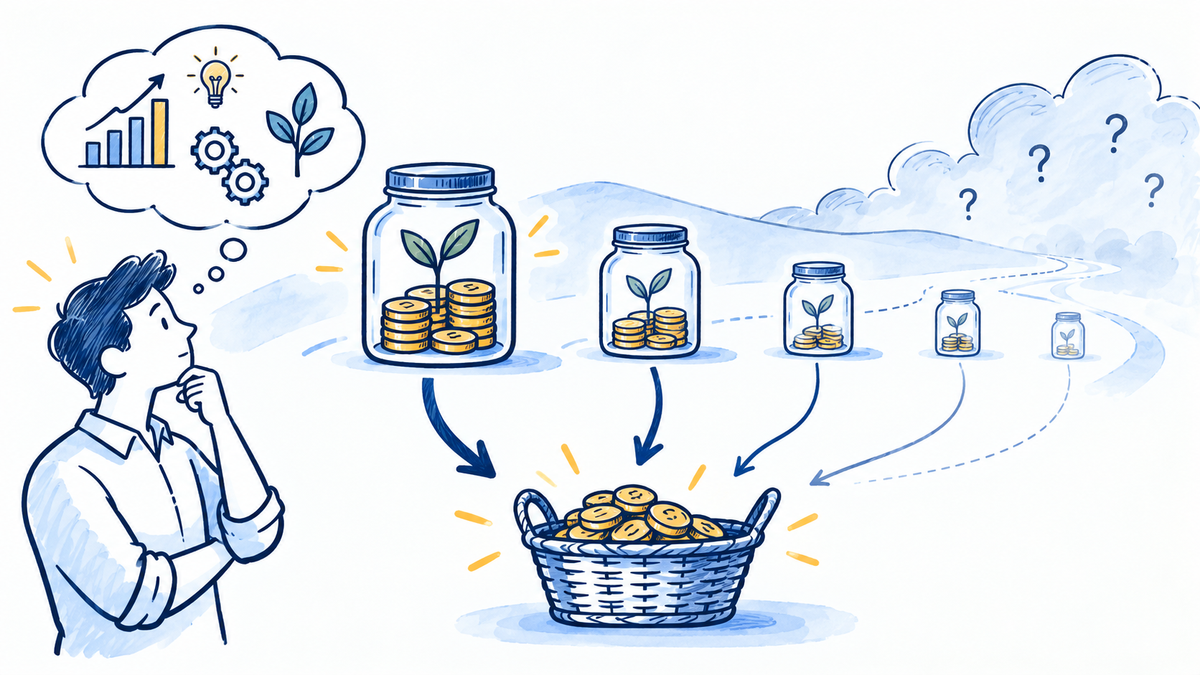
Bring future cash into the present
A hypothetical $110 received one year from now is worth $100 today at a 10% annual discount rate. A $121 receipt in two years is also worth $100 at that rate because $121 divided by 1.10 squared equals $100.
The rate reflects an opportunity cost and risk assumptions, not a promised return. Use a currency consistent with the cash forecast. Nominal cash forecasts require a nominal discount rate. A small change in the rate can materially change the result.
Treat terminal value with care
For a stable perpetuity, value at the end of the forecast period equals the following year’s cash flow divided by the discount rate minus the sustainable growth rate. The discount rate must exceed that growth rate.
If next year’s stable cash flow is $10 million, the rate is 10% and perpetual growth is 2%, value at that point is $125 million. It must still be discounted if that point lies in the future. Growth also requires reinvestment and cannot simply be added without cost.
Bridge operations to each share
Add nonoperating assets when appropriate and subtract debt and other claims to reach equity value. Divide by a share count consistent with potential dilution. Avoid adding cash already included in forecast distributions.
Present a range using different growth, margin, reinvestment and discount assumptions. Explain which assumptions drive the range. A spreadsheet can be mathematically exact while its business forecast remains uncertain.
Try it yourself
A one year cash receipt is $220 and the appropriate discount rate is 10%. What is its present value? What if the rate is 20%?
Show the worked answer
At 10%, present value is $220 divided by 1.10, or $200. At 20%, it is about $183.33. The same future receipt has a lower present value when the required discount rate rises.
Further reading
Educational material. Examples are hypothetical and do not recommend a security or a personal allocation.


