

Building a Fund Portfolio · Mutual Funds
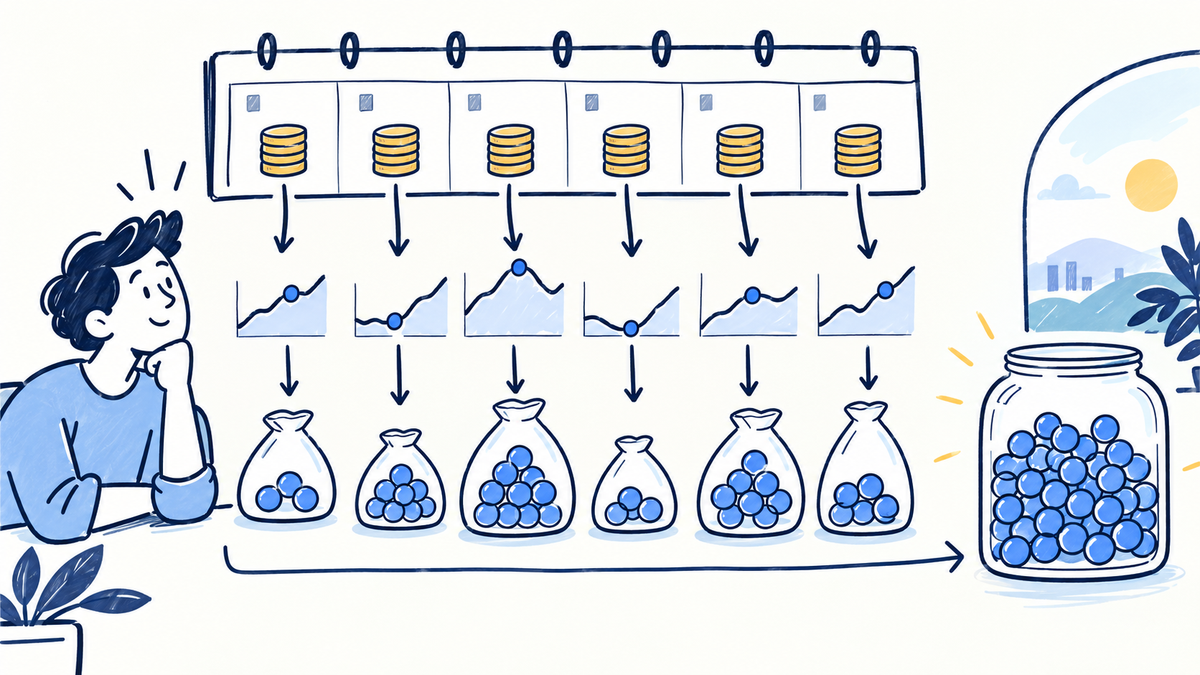
Regular investing creates a repeatable contribution process. It changes the prices at which units are purchased, but it does not guarantee a profit or make an unsuitable fund safe.
See how fixed contributions buy units
If you invest $100 at unit prices of $10, $8 and $12, you buy 10, 12.5 and approximately 8.333 units. Total contributions of $300 purchase about 30.833 units, giving an average cost near $9.73 per unit before fees. More units are purchased when the price is lower.
Do not mistake average cost for a return
The account's current value depends on the current unit price and any distributions. A lower average purchase price than the arithmetic average of quoted prices does not prove that the strategy outperformed another investment schedule. A proper comparison must account for when money was available, invested or left in cash.
Separate new savings from an existing lump sum
Investing part of each paycheck is different from holding an already available sum in cash and releasing it gradually. Gradual investment reduces immediate market exposure, which can help if prices fall but can lag if markets rise. The tradeoff concerns risk timing and behavior, not a guaranteed mathematical advantage.
Account for practical frictions
Minimum purchases, sales charges, platform fees and account rules can affect small contributions. Confirm that automated purchases use the intended share class and do not create avoidable charges. Keep sufficient cash for obligations so a recurring instruction does not force a later redemption at an inconvenient time.
Keep reviewing the investment itself
A regular schedule cannot repair an expensive or unsuitable product. Continue checking the fund's role, costs and mandate. If the investment thesis changes, review it deliberately rather than treating an automatic contribution as a reason to stop thinking.
Try it yourself
You invest $120 at a unit price of $12 and another $120 at $8. How many units do you own and what is the average cost?
Show the worked answer
You own 10 plus 15, or 25 units. The average cost is $240 divided by 25, or $9.60 per unit before costs. Profit still depends on the subsequent value and distributions.
Further reading
- SEC Investor.gov: Asset allocation, diversification and rebalancing
- SEC Investor.gov: Mutual fund and ETF fees and expenses
- FINRA: Mutual funds
Educational material, not a recommendation to buy or sell a fund. Numerical examples are hypothetical. Fund terms, investor eligibility and tax treatment vary by product, account and jurisdiction.
Continue learning
- Previous lesson: Building a core mutual fund allocation
- Next lesson: Rebalancing with contributions and withdrawals
- Explore all Mutual Funds lessons


