

New Zealand's unresolved election adds a political test to AUD/NZD just as Australia's policy rate advantage has widened. Preliminary results from the 7 November vote leave the incumbent coalition with a narrow projected majority, while the official count remains outstanding. The useful currency question is whether that uncertainty changes the expected policy gap, rather than which party leads the first count.
A preliminary majority is not a settled government
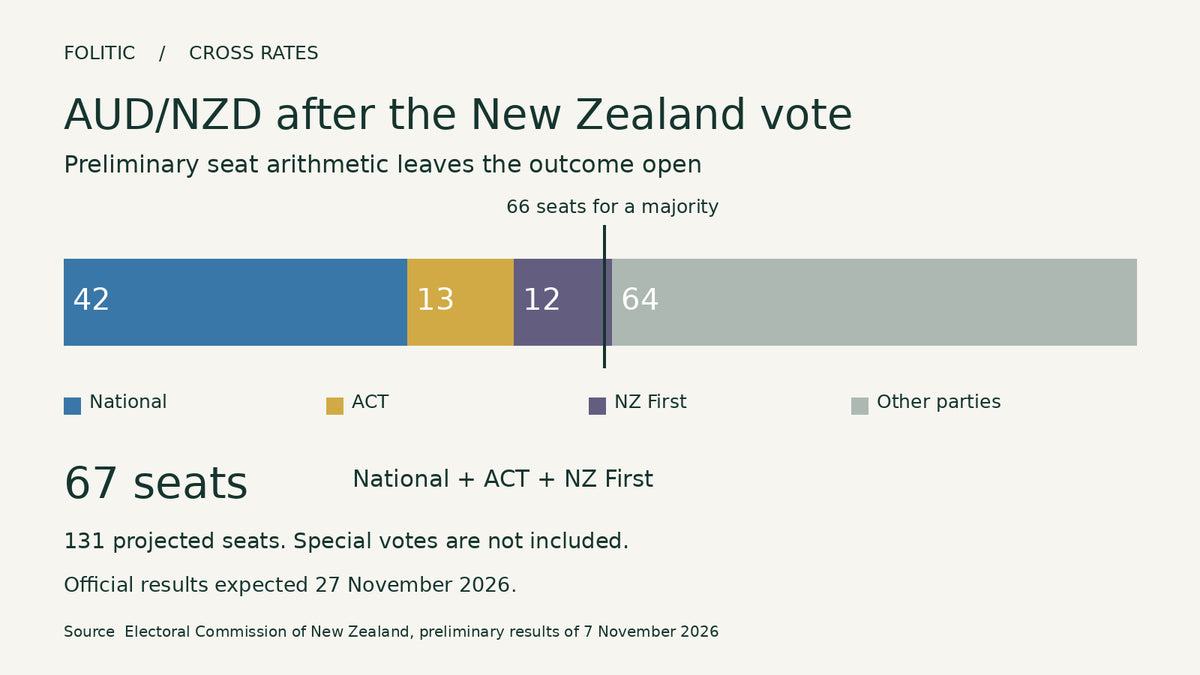
The Electoral Commission's preliminary results allocate 42 seats to National, 13 to ACT and 12 to New Zealand First. Together that is 67 of 131 projected seats, against a majority threshold of 66. The commission estimates about 399,365 special votes still need checking and counting. Official results are expected on 27 November.
Those figures establish the uncertainty. They do not establish a final coalition agreement or a new fiscal programme. For currency analysis, the next meaningful development is evidence about government formation and the resulting spending, tax and investment settings. Assigning a fixed currency premium to the preliminary seat count would go beyond the available evidence.
The exchange rate moved against the simple uncertainty story
The AUD/NZD pair measures New Zealand dollars per Australian dollar. The RBA's daily published series shows 1.2401 on 6 November and 1.2328 on 9 November. The change between those dated observations is a decline of about 0.59%. A lower pair means the New Zealand dollar strengthened against the Australian dollar.
These are daily statistical observations published by the RBA, not executable bid or ask quotes, a live feed or a verified change over the last 24 hours. No intraday observation time is asserted here. The figures are taken directly from the New Zealand dollar row of the RBA table, rather than calculated from separate US dollar pairs.
The observed decline warns against assuming that an unresolved election must immediately weaken the kiwi. It does not prove the vote caused the move. Broader risk sentiment and changing expectations for either economy can affect the cross at the same time. The election is a new source of uncertainty to monitor, not a sufficient explanation for every price change.
Australia has a larger rate gap but a slowing economy
The RBA raised its cash rate target to 4.85% on 3 November. Its statement describes broad inflation pressure alongside slowing activity, falling housing prices and higher unemployment. More restraint can support the relative interest rate case for the Australian dollar, but it also adds pressure to spending.
New Zealand's central bank held its official cash rate at 2.75% on 28 October. Four members supported a hold and three preferred a quarter point increase. The bank described an uneven recovery and continuing inflation risks. A pause therefore does not establish that further tightening is off the table.
The difference between the two policy settings is 2.10 percentage points. That compares with 1.85 points before Australia's November increase, a widening of 25 basis points. This is arithmetic on central bank settings, not a bond yield spread, a forward exchange rate or an attainable investment return. Funding costs and exchange rate movements can outweigh it.
FOLITIC's analysis of the RBA vote examines Australia's decision in detail. Here the distinct issue is how the new political uncertainty in New Zealand interacts with the relative path of the two economies.
What would change the direction of the cross
A credible governing arrangement that reduces uncertainty, alongside evidence favouring additional New Zealand tightening, could support the kiwi and put downward pressure on AUD/NZD. That case would be weaker if Australian inflation remained persistent enough to require a larger relative policy response.
Conversely, prolonged uncertainty that delays investment or weakens confidence could weigh on New Zealand's outlook and support a higher AUD/NZD. A sharper Australian slowdown could offset that channel. These are conditional scenarios, not price targets or claims that a particular coalition necessarily strengthens or weakens the currency.
For an Australian importer with a fixed New Zealand dollar invoice, a lower AUD/NZD means more Australian dollars are needed to pay it. For an Australian investor holding an unhedged New Zealand asset, the same move supports its Australian dollar translation, other things equal. The underlying asset's performance and any hedge can change the total result.
The next seven days
For the period from 9 to 16 November, the ABS calendar lists September quarter lending indicators on 11 November and September international travel data on 12 November, both at 11.30 am AEDT. They can inform the assessment of Australian credit demand and travel activity. They are not forecasts of those releases.
Stats NZ's published release notices schedule September migration and September travel data for 12 November. The figures may refine the demand and labour supply context in New Zealand. The official election result on 27 November lies beyond this seven day window.
The practical test is whether new evidence alters relative growth and inflation expectations enough to outweigh the existing policy gap. FOLITIC's guide to interest rate expectations and currencies explains why the current rate level alone cannot settle that question.
Original FOLITIC graphic using Electoral Commission preliminary seat data published on 7 November 2026. The graphic is not a forecast of the official result. Analysis and daily exchange rate comparison as of 9 November 2026.


