

Pricing and Yields · Bonds Explained
Name the measure before comparing it
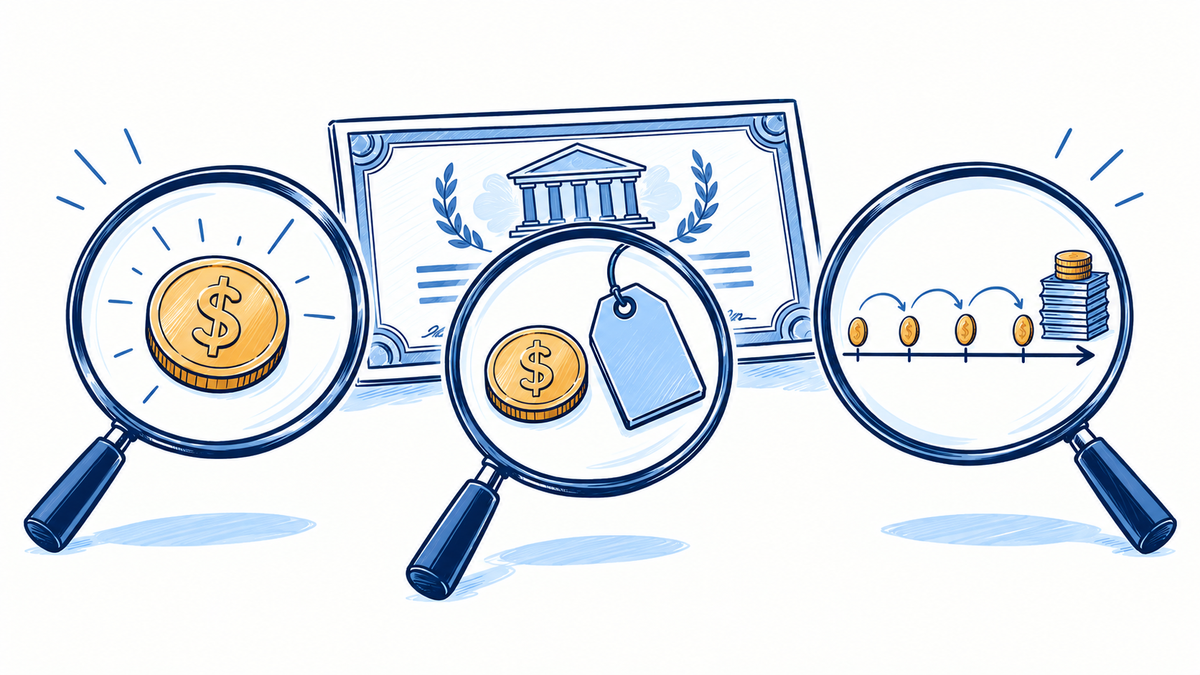
Coupon rate relates annual contractual interest to face value. Current yield relates annual coupon cash to the quoted bond price. Yield to maturity is the discount rate that equates the full scheduled cash flows with the investment price.
A conventional current yield calculation ignores the gain or loss between purchase price and principal repayment. It also ignores the timing of coupons. This makes it an income snapshot rather than a complete return forecast.
Use the same bond three ways
Consider a hypothetical bond with $1,000 face value, a $40 annual coupon, one year remaining and a purchase price of $980 on a coupon date. Its coupon rate is 4%. Current yield is $40 ÷ $980, or about 4.08%.
With one final payment of $1,040 exactly one year later, yield to maturity is $1,040 ÷ $980 minus 1, or about 6.12%. The extra return comes from buying below the scheduled principal repayment amount. Costs and taxes are excluded.
Separate a discount rate from a realised outcome
The mathematical yield uses promised payments. A default, early sale, call, cost or tax can change the outcome. For a bond with interim coupons, achieving the same compound return over the full horizon also depends on how those receipts are reinvested.
A yield quoted using semiannual compounding is not directly equivalent to an effective annual yield. Record the quotation convention before comparing two numbers that look similar.
Build a comparison line
For each candidate, list price, face value, coupon, payment frequency, maturity, call terms and the yield convention. Ask whether the yield is calculated before or after transaction costs. Avoid comparing a fund’s distribution yield with an individual bond’s yield to maturity as if they measured identical cash flows.
Try it yourself
A one year bond pays $1,050 at maturity and costs $1,020 today. What is its yield to maturity under annual compounding?
Show the worked answer
The yield is $1,050 ÷ $1,020 minus 1, or about 2.94%. It is not the 5% coupon rate on $1,000 face value.
Further reading
Educational material. Examples are hypothetical and do not recommend a security or a personal allocation. Contract terms and market conventions vary.
Continue learning
- Previous lesson: Why bond prices move when yields change
- Next lesson: Yield to worst and reinvestment risk
- Explore all Bonds Explained lessons


