

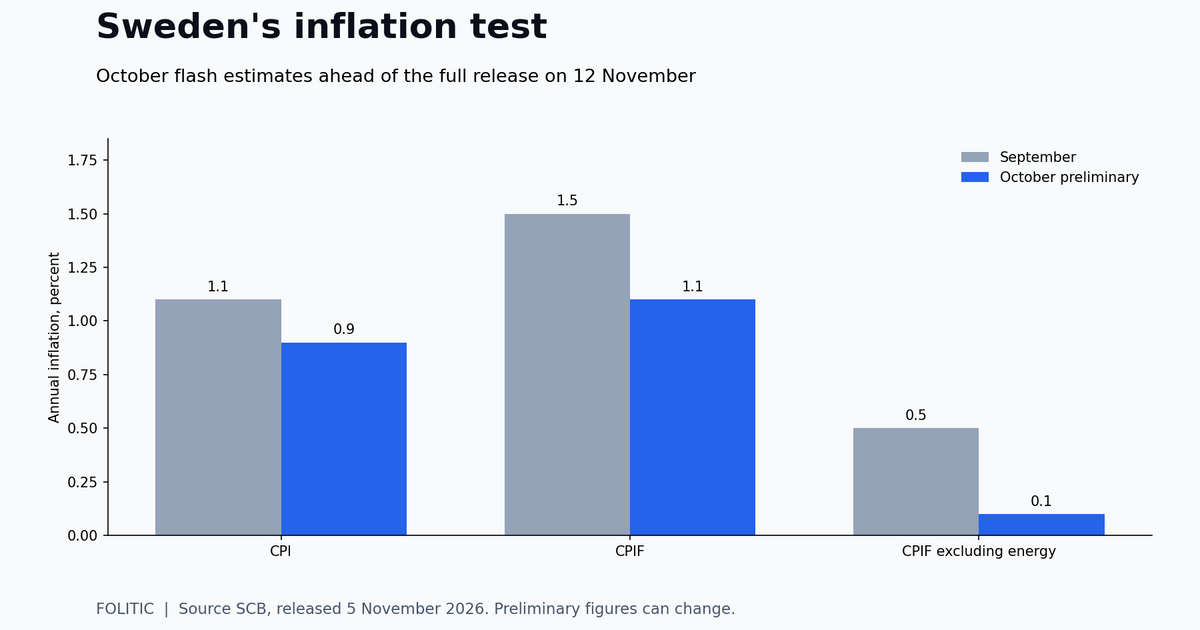
EUR/SEK faces a fresh information test on 12 November, when Statistics Sweden releases the full October inflation report. The question is whether the detail supports the Riksbank's expectation of renewed price pressure or gives investors reason to question further tightening.
The flash estimate published on 5 November put annual CPIF inflation at 1.1%, down from 1.5% in September. CPIF excluding energy slowed to 0.1% from 0.5%. These are preliminary observations, not figures released today. The regular publication is scheduled for 12 November at 8 a.m. Swedish time.
What the full release can add
CPIF holds mortgage interest rates constant and is the Riksbank's target measure. CPI does not hold those rates constant. Neither the CPIF headline nor the measure excluding energy removes every temporary fiscal effect. A low reading therefore cannot by itself establish how persistent inflation will behave when temporary measures expire.
The Riksbank's 4 November decision emphasised stronger activity, supply costs and the weaker krona as reasons inflation could rise next year. It raised the policy rate to 2%, effective 11 November, and made further increases conditional on the outlook holding. FOLITIC's policy implementation analysis explains that decision.
The additional issue for the cross is the composition of October's slowdown. Broad moderation in persistent components would challenge the case for further increases more directly than a decline concentrated in temporary influences. The detailed report could also revise the flash figures. This article does not assume either outcome or claim a consensus forecast.
Compare the Swedish signal with the euro side
The ECB held its deposit rate at 2.50% on 29 October. It described an energy shock that raises inflation risks while restraining activity. That tension matters because EUR/SEK reflects expectations for both economies, not Sweden alone.
If the Swedish detail reinforces expectations of further tightening while the expected ECB path changes little, it could support the krona. If it instead weakens Sweden's tightening case, or euro area expectations rise faster, the relative argument could favour the euro. These are conditional transmission channels. No intraday reaction, bond yield move or market probability is asserted.
The current policy settings are not a direct measure of a currency trade's return. Borrowing terms, forward pricing, transaction costs and changes in the spot rate can outweigh an apparent interest rate advantage. Global risk aversion can also weaken a small currency even when domestic rates rise.
Read the cross in the correct direction
EUR/SEK expresses Swedish kronor per euro. A rise means the euro strengthens and the krona weakens. A fall means the krona strengthens. For a Swedish business paying euro invoices, a higher cross raises the krona cost before hedges or price adjustments. A Swedish exporter receiving euros has the opposite conversion exposure, although imported inputs can offset the benefit.
For a euro based investor holding unhedged Swedish shares, a stronger krona can improve the euro value of the investment even if the local share price is unchanged. A hedge changes that exposure and has a cost. These currency effects are separate from the company's operating performance and valuation.
FOLITIC's forex tools provide context for currency comparisons. No current EUR/SEK quote is used here. The original chart compares September observations with October preliminary inflation, not exchange prices or predicted returns. Analysis is dated 10 November 2026.


